

#150 AI Impact Summit: Conversations on Sovereignty and Infrastructure
In this edition of Technopolitik, Bharath Reddy and Anwesha Sen discuss trends on sovereignty, competition, and AI infrastructure at the AI Impact Summit.
This newsletter is curated by Anwesha Sen.

On Sovereignty and Competition
“Sovereignty” was one of the most commonly used terms during the AI summit. It is a political term that has been transposed to technological contexts to mean a range of nebulous things. What we need with AI or other critical technologies is not to do everything ourselves, but to have a resilient technology ecosystem and to make decisions about the technology we use based on India’s national interest.
With orders-of-magnitude differences in investment and other structural challenges, market concentration in frontier generative AI models is likely, with a few companies dominating. Several ideas that were proposed across the panel discussions to deal with market power and the geopolitics around AI. Some ideas seem outside the Overton window, but from what we see over the past few years, things can change fast:
The “moat” is no longer just data or models, but distribution. The AI stack is being built on an internet ecosystem (browsers, search, OS) that is already monopolised, making fair competition nearly impossible without intervention. Big Tech can capture downstream innovation by integrating AI into their walled gardens. Some of the panellists called for ex ante regulation through competition policy and industrial policy. But others opined that it would stall or hinder innovation in India.
Data protection and copyright are at odds with AI development. If developing countries are very protective about data rights, they will miss the window to influence foundation models.
A “Visit, Don’t Move” architecture was discussed for data residency. Instead of data leaving the country to train models in the West, the models should come to local “clean rooms,” train, and leave only the updated weights behind.
We might see regions (like India, Africa or other digital alliances) attempting to form “Data Blocs.” Smaller groups lack leverage, but a bloc controlling the data of 1 billion people could force Big Tech to concede model weights or value in exchange for access. Conversely, others argue for strong community governance and “marketplaces” where value is extracted back to the community.
There was much talk about small models that can run on edge device with resource constraints that might be the use cases that unlock opportunities for a vast majority of Indians. Think of a farmer trying to understand which crops she needs to plant based on market factors or weather conditions, or one that can identify pests based on crop images and suggest remedies.
Open source was widely discussed as a viable mechanism to restore competition. However, the ecosystem is quite fragmented. It needs to be able to compete with proprietary systems when time to market is the primary concern for developers. Efforts are required to make discovery and distribution as seamless as possible.
Overall, the path to sovereignty for a middle power like India lies not in building the next frontier model but in making innovation accessible across sectors such as agriculture, healthcare and education. This could mean accessing a frontier model from an American lab, an open-source model that meets your specific needs, or an indigenous model that outperforms in certain contexts.
On AI Infrastructure
At the recent AI Impact Summit, a clear consensus emerged: the future of AI is in power grids and access to compute. As the ecosystem shifts from experimentation to diffusion, several defining trends are reshaping compute, data centres, and power.
India’s data centre capacity, currently at around 1.7 GW, is projected to surge to 8 to 10 GW by 2032. To bridge this gap, the government is acting as a market maker rather than just a regulator. The Union Budget 2026-27 announced a 21-year tax holiday for foreign firms using domestic data centres to serve their global customers. In doing so, the budget provides long-term tax assurance for firms setting up infrastructure in India and invites investments. However, the overall benefits for the Indian ecosystem are unclear as the tax holiday doesn’t apply to Indian customers.
But building data centres isn’t enough. Massive infrastructural upgrades are necessary to support the ecosystem. Power and water are no longer afterthoughts but fundamental design constraints. Data centres require 24/7 reliable electricity as well as up to 1.5 million litres of water daily in hyperscale data centres for more effective cooling than air cooling (not taking into account water recycling or closed-loop systems). Consequently, there is increased attention being paid to sustainability being integrated at the foundational design level.
However, one-size-fits-all approaches to sustainable data centres also don’t work. Summit discussions emphasised localised infrastructure approaches. For example, utilising air-cooled chillers in water-stressed regions despite their higher power requirements, and localised regulations based on resource availability. To harmonise these efforts and avoid fragmented regulations, the Asia Pacific Data Centre Association championed the Sustainable Digital Infrastructure Accord (SDIA), a voluntary framework (yet to be published) setting regional baselines for energy efficiency, water usage, and carbon-free energy.
Furthermore, to manage the massive power loads on centralised data centres, the industry is also investing in edge AI, moving intelligent processing directly onto devices to reduce latency and energy consumption. Recognising that no single nation can own the entire AI supply chain, geopolitically, the conversation has matured from an isolationist view of total self-sufficiency to strategic agency.
The other prong in developing AI infrastructure is access to compute. Through the India AI Mission, the state is underwriting compute costs to offer GPU access to startups and researchers at roughly INR 65 per hour—a fraction of the global USD 2.50–3.00 rate. However, for low- and middle- income countries, exploring shared and open compute hubs by pooling capital and resources to secure equitable access to frontier models without being bound to oligopolies is key.
Limiting incentives to specific strategic areas is necessary to simultaneously innovate in a frugal manner. A focused approach to foster shared open compute hubs in addition to short-term GPU cost subsidies via the India AI Mission avoids fiscal overreach, counters oligopoly dominance, and builds resilient infrastructure. By acting as a precise market maker, and not a blanket provider, India can scale AI diffusion efficiently, turning resource constraints into competitive advantages.
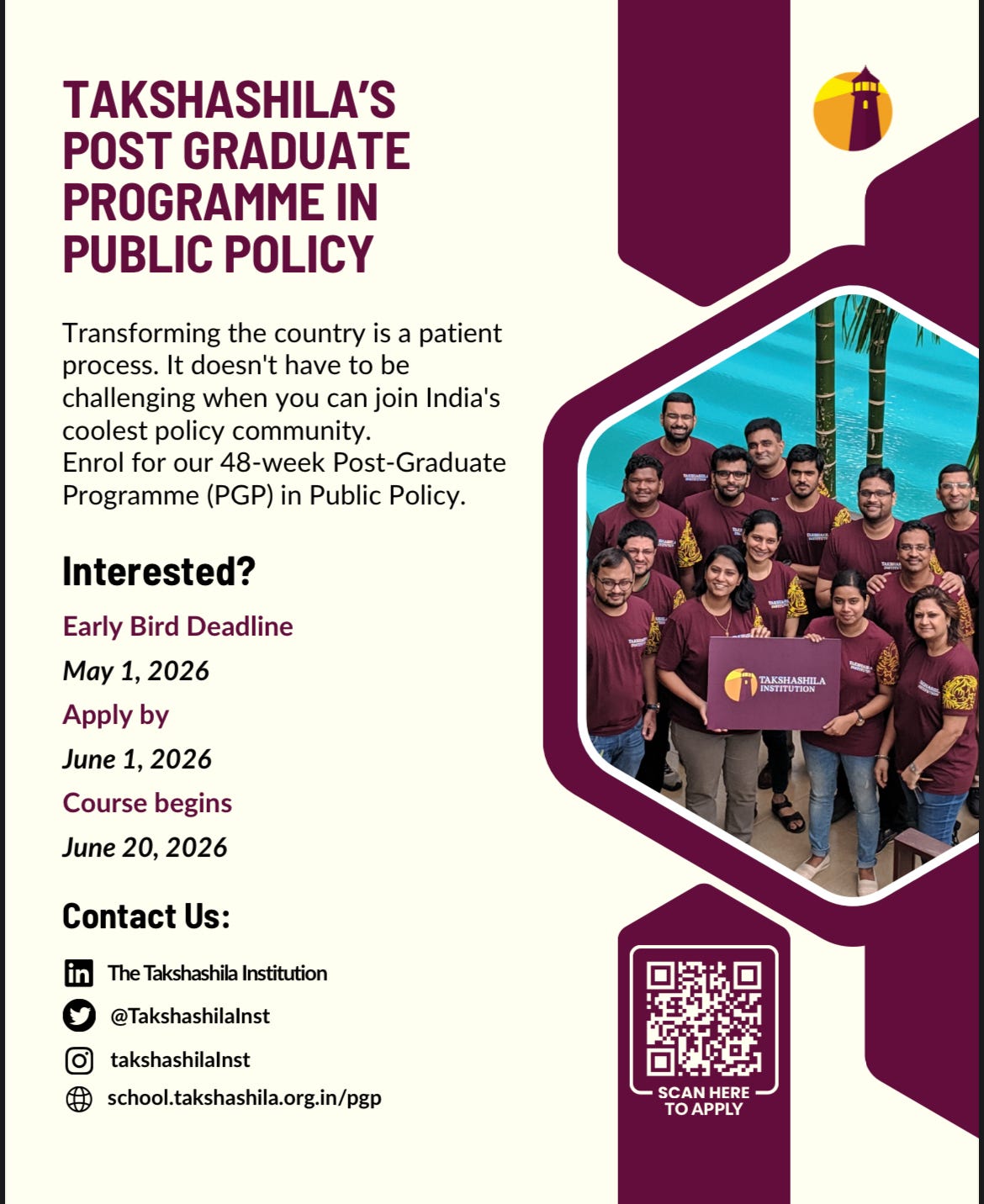
The Post Graduate Programme in Public Policy is a comprehensive 48-week hybrid programme tailored for those aiming to delve deep into the theoretical and practical aspects of public policy. This programme emphasises both academic knowledge and hands-on experience, blending conceptual learning with policy simulation exercises. Beyond the online webinars, students also get the added advantage of engaging with Takshashila’s esteemed subject matter experts and its vast alumni community.
Overall, this intensive programme will arm you with all the essential skills for policymaking, analysis, persuasion, and communication, preparing you for your chosen career path in public policy.
And before you go-
Check out Grammar of War, a newsletter by Adya Madhavan, that looks at advanced military technologies!