

#147 Budget Analysis: Semiconductors, Cloud Services, and Rare Earth Minerals
In this edition of Technopolitik, Pranay Kotasthane, Anwesha Sen, Arindam Goswami, and Shobhankita Reddy analyse the implications of the Union Budget 2026-27 on semiconductors, global cloud services, and rare earth minerals. This is part 2 of the Budget Analysis.
Read part 1 of the analysis on AI, R&D, and Innovation here.
This newsletter is curated by Anwesha Sen.

Analysing the Progress of Semiconductor-related Policies through Budgetary Allocations
The latest union budget speech mentions that the government plans to launch a second version of the India Semiconductor Mission. As four years have passed since the launch of India Semiconductor Mission 1.0, now is a good time to assess progress using the government’s own spending data. And to make a fair assessment, we must go beyond speeches and announcements.
Thus, I looked up the budget data for all the years since the policy came into effect, and the results suggest a huge gap between promise and delivery.
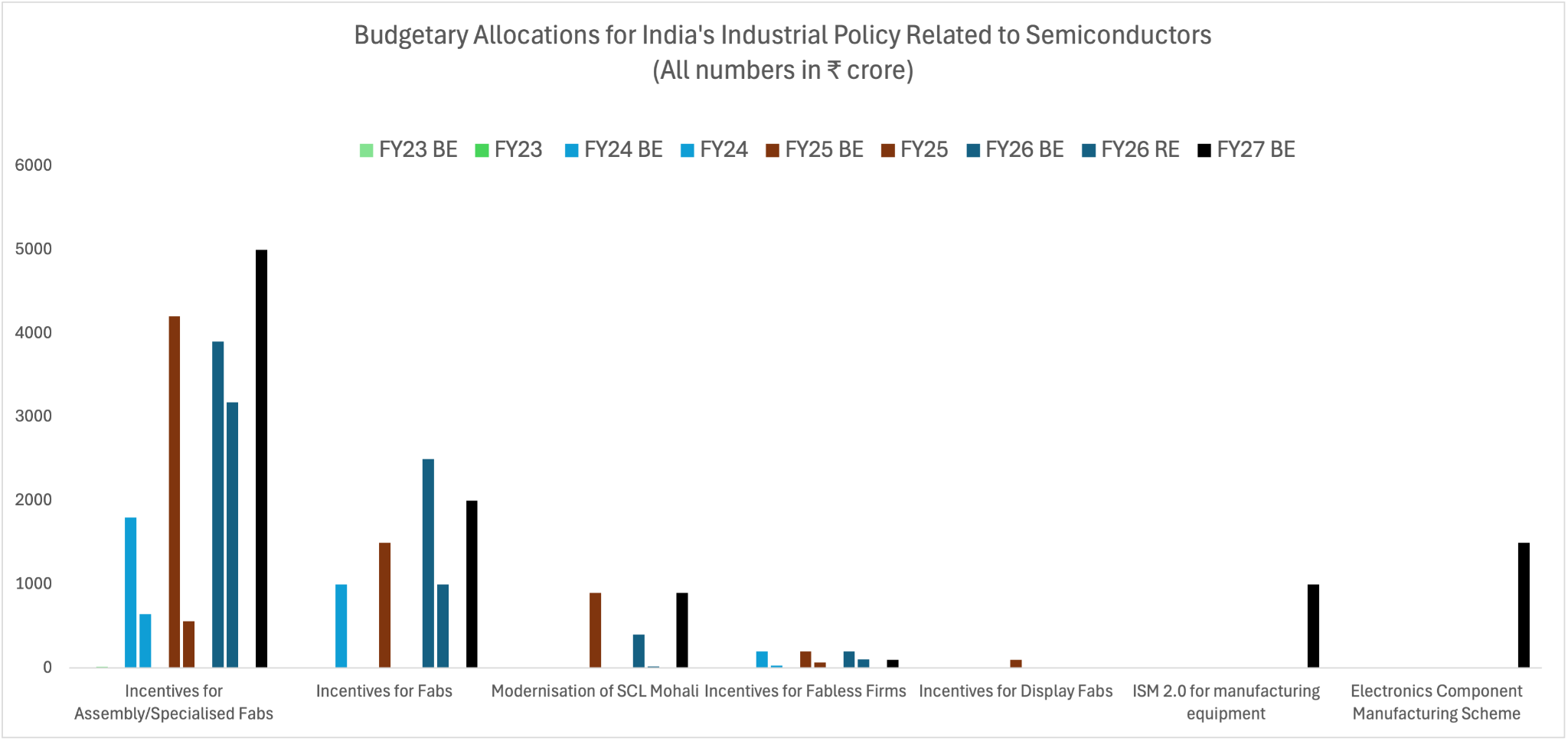
Author’s chart based on budget data
The chart above shows all budgeted and disbursed amounts to date. Every financial year has two bars of the same colour. The first bar shows the expenditure forecast for the beginning of that year (also called budgeted estimates, or BE). The second bar of the same colour shows the actual disbursements at the end of that financial year (actuals). The difference between ex-ante budget allocation vs actual spending is especially important because the policies have front-loaded the disbursement on an equal footing basis during capital acquisition and construction stages, instead of making financial support incumbent on production.
In FY27, the government expects to spend ₹8000 crore (~10 per cent of the total outlay) for the already approved projects under ISM1.0. Breaking down this overall number indicates the health of each sub-scheme.
The one area which seems to be proceeding well is the scheme for chip assembly and testing. While there is still a vast gap between the budgeted estimates and disbursals, the steady rise in disbursements in absolute terms indicates on-ground progress.
The budgeted outlay for a fab shows a muted picture. Despite the budgeted allocations for the Dholera fab in FY24 and FY25, not a single penny was disbursed. The FY26 revised estimate is also substantially lower than the budgeted allocations. Thus, it indicates that the project is progressing much more slowly than the government’s own projections.
Next, the government has been planning to modernise the government-owned R&D fabrication unit in Mohali this year without much success. Despite allocating money for it in several budgets, virtually nothing has been spent yet.
The sad disappointing concern is a sector where India’s comparative advantage actually lies, i.e., fabless firms. The Design-linked incentive promised to support 100 start-ups in their go-to-market strategy, but the disbursals show how far off the target the scheme is. There was no disbursement in FY23; The FY24 disbursements were 15 per cent of the budgeted allocation of ₹200 crore; the FY25 disbursements stood at 34 per cent of the budgeted expense; and the FY26 disbursements stood at 52 per cent. In FY27, the budgeted expenditure is ₹100 crore. The reasons for tardiness include strict provisions that put firms raising substantial foreign money out of contention, confusion on the government’s right to the company’s intellectual property, and entrusting a government company, which is also a player in this domain, as the nodal regulator of this scheme.
The display fab scheme hasn’t attracted any interest, and the government hasn’t budgeted any amount for it this year either. I have long argued that display fabs are not strategic, and spending taxpayer money on them merely to reduce imports from China is not sensible. Good riddance if the government stops wasting time, money, and effort here. Let private players build these display fabs on their own dime. Provide reliable electricity and reliable land titles instead.
The headline announcement is India Semiconductor Mission 2.0. The new mission aims to move beyond fab construction to focus on semiconductor equipment, materials, and full-stack Indian IP development. A budget of ₹1,000 crore has been allocated for FY27, indicating a gradual ramp-up.
A related scheme is the Electronics Component Manufacturing Scheme. The Finance Minister announced that there was a high demand for this scheme and hence the outlay for this scheme was raised to ₹40,000 crore from ₹22000 crore. Here again, the government is planning a spend of ₹1500 crore in the next financial year.
To summarise, India’s semiconductor journey remains a work in progress. The assembly segment shows genuine momentum, but fab construction is behind schedule, SCL Mohali modernisation remains more promising than reality, and the design ecosystem—where India has natural strengths—continues to be let down by poorly designed incentive structures. ISM 2.0’s focus on equipment and materials is strategically sensible, but execution will be key. As with previous years, the gap between announcements and allocations, between budgeted amounts and revised estimates, tells the real story.
Tax Holiday for Global Cloud Services
The Union Budget 2026–27 has proposed a 21-year tax holiday, until 2047, for foreign companies that provide global cloud services using data centre infrastructure located in India. These firms are required to route their Indian business through a domestic reseller entity, which gives them a clearer and more predictable tax presence in the country. The idea is to make large, long-term data centre investments easier to plan and less exposed to sudden tax changes.
To cut down on transfer pricing disputes, the Budget also brings in Safe Harbour provisions for data centre and IT services. A Safe Harbour is a predefined profit margin that, if used, is generally accepted by the tax department without detailed audits, reducing uncertainty and compliance costs. For related-party data centre services tied to foreign cloud operations, the margin is set at a 15% mark-up on cost, in line with a 15.5% margin now applied more broadly to IT and IT-enabled services under a single “Information Technology Services” category.
There is a similar Safe Harbour for component warehousing. Non-resident companies can keep key server and network parts in bonded warehouses in India at a fixed profit margin of 2% on the invoice value, which works out to an effective tax rate of around 0.7%, lower than in many competing regional hubs. Together, these provisions are meant to make it easier and cheaper for global cloud providers to base more of their infrastructure and logistics in India.
While India does have a talent shortage, people can be trained. Microsoft, for instance, is already working with the government on large upskilling programs. Universities can update their courses and online platforms can quickly expand training.
But how far these tax measures go in shaping investment decisions will also depend on what happens outside the tax code. The build-out of reliable and modernised power grids, high-quality connectivity, and smoother land acquisition processes for new data centre sites will be critical. Without progress on these fronts, the benefits of the new incentives may be harder to realise at scale.
Building power infrastructure takes at least ten years. Gas-fired plants need six years from planning to completion, and onshore wind projects take about the same. India’s move toward renewables, which is crucial for its 2070 net-zero goal, also means it needs large-scale battery storage, a technology still being tested worldwide. Up to 40% of a data centre’s energy is used just for cooling. AI workloads produce a lot of heat, and in India’s climate, the need for cooling is even greater.
However, there was no mention of dedicated power generation for data centres. India should make reliable power the foundation of its AI strategy. This involves three steps - setting up renewable energy zones next to data centre parks, speeding up regulatory approvals for power infrastructure linked to key tech investments, and requiring sustainability standards that match our climate goals while ensuring nearly 100% uptime.
Tax breaks may attract attention, but reliable power is what truly matters. Without it, billions in foreign investment will go to places like Vietnam, Indonesia, or the Middle East, where energy infrastructure is being built together with data centres, not as an afterthought.
Rare Earth Minerals
The Union Budget speech mentioned rare earths twice. While this signalled intent, a closer reading reveals a wide gap between ambition and execution.
Firstly, there was a reference to ‘The Scheme to Promote Manufacturing of Sintered Rare Earth Permanent Magnet (REPM)’ announced in November 2025 in the speech. This was envisaged as a Rs. 7280 crore allocation spread over seven years, with the initial two years as the gestation period for constructing the required facilities. This marked India’s first effort to build an integrated domestic processing and manufacturing ecosystem and was split as a sales-linked incentive alongside an initial capital subsidy of Rs. 750 crore to support the setup of the manufacturing facility. Interestingly, this capital subsidy is completely missing from the budget outlay, and the scheme is not mentioned at all in the documents.
Second, the Finance Minister proposed to “support the mineral-rich states of Odisha, Kerala, Andhra Pradesh and Tamil Nadu to establish dedicated rare earth corridors to promote mining, processing, research and manufacturing.” This is noteworthy for two reasons, even as more details are awaited. One, most of the rare earths in these coastal states are present in their beach sands, particularly in monazite, which is a prescribed substance under the Atomic Energy Act because of its thorium content. Currently, beach sand exploration and mining are not open to the private sector. Two, despite a Rs. 1500 crore outlay under the National Critical Mineral Mission (NCMM) for recycling, which has the potential to shift focus from primary mining to recovering value from e-waste and countering Chinese dominance in processing, there was no mention of this part of the value chain in the budget speech.
Looking beyond the budget speech and into the numbers reveals a sober reality. The NCMM is still nascent. Launched in Jan 2025 with a budgeted expenditure of Rs. 16300 crore over seven years, the budget outlay in FY 25-26 and FY 26-27 is ~Rs. 400 crore. The FY 25-26 revised estimate further showed a significant drop to Rs. 90 crore, indicating slow progress overall.
Additionally, the budget outlay for the last three years under the ‘Geological Survey of India (GSI) Activities’ and the ‘Amount met from National Mineral Exploration and Development Trust (NMEDT) Fund’ line items has remained the same.
The GSI does the heavy lifting of much of the early-stage exploration work in the country and is tasked with a target of 1200 projects under the NCMM by 2031. GSI activities include geological mapping, satellite imaging and other mineral assessments in the country. NMEDT contributions are pooled from mining and composite license holders and charged at 2% of the royalty paid. These are collected by state governments, transferred to the consolidated fund of India, and used for exploration activities by the GSI, the Indian Bureau of Mines, and empanelled private players.
This exploration expenditure is necessary since the 2015 Mines and Minerals Development and Regulation Amendment Act shifted the allocation process from first-come, first-served to auctions. Both figures remaining fairly constant over the past three years is bad news and reveals capacity constraints that would constrain the pipeline of auctionable blocks. Consequently, this would have a negative impact on any meaningful uptake in subsequent auctions and private-sector investment in the sector.

The Post Graduate Programme in Public Policy is a comprehensive 48-week hybrid programme tailored for those aiming to delve deep into the theoretical and practical aspects of public policy. This programme emphasises both academic knowledge and hands-on experience, blending conceptual learning with policy simulation exercises. Beyond the online webinars, students also get the added advantage of engaging with Takshashila’s esteemed subject matter experts and its vast alumni community.
Overall, this intensive programme will arm you with all the essential skills for policymaking, analysis, persuasion, and communication, preparing you for your chosen career path in public policy.
And before you go-
Check out Grammar of War, a newsletter by Adya Madhavan, that looks at advanced military technologies!
The rare earths section really highlights the execution problem. Budget speeches mentioning REPMs twice but then quietly dropping the 750 crore capital subsidy is telling. I worked briefly with a mineral processing pilot project and the mismatch betweenpolicy announcements and ground-level funding was always the chokepoint. The beach sand issue is underappreciated too, thorium regulation basically locks out private players from monazite-rich zones.